This week I’ve spent countless hours poring over English-Spanish dictionaries and Medical Spanish for Pediatric Medicine as I prepare to take the Bilingual Fluency Assessment for Clinicians (eBFAC). As a pediatric neurology resident, I paid particular attention to the neurodevelopment and neurologic vocabulary as these are the words I anticipate needing most often. To my surprise, sordo was the word for both “dull” (ex: dull pain) and for “deaf”. I started down a rabbit hole about how we discuss disabilities in Spanish, and honestly I’m not sure where it’s leading me (that’s why I’m here processing with all of you!). But if language influences culture and culture influences language, and language and culture both play a critical role in how we talk to patients and how they perceive their diagnosis, it’s a question worth asking.
I posted this on my Instagram story as a loose academic exercise:
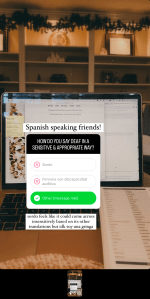
To my surprise, it was a very divisive question. Of the 618 people who viewed this story, 20 people voted. 7 voted for “sordo“, 8 voted for “persona con discapacidad auditiva“, and 2 people chose the third option (one was my non-Spanish speaking husband so his answer was excluded to maintain a semblance of study validity). The person who chose the third option messaged me and offered “problemas de audición“. Some people felt that sordo was definitively offensive, others felt uncomfortable with sordo but did not feel that there were any better options, and some felt that sordo was both accurate and non-problematic.
The more I looked into this, the more confused I became. For example, there isn’t a direct translation of impairment, but most people use problema or limitación. To me, these do not convey the same meanings depending on the clinical context. Another example, and perhaps the most clear in my mind, is developmental delay, which is translated as retraso de desarrollo. However, when you translate retraso back to English, it directly translates as retardation or delay. Technical, but problematic at least in English. As a non-native Spanish speaker, I admit that I do not fully understand the social nuance of the word retraso, and still have much to learn.
My next step to learn more about this was to turn to the internet. I searched in English, but was unable to find any hits discussing this exact topic. Then I searched “cómo hablar sobre las discapacidades“, and found this amazing website from Anáhuac Mexico that had a really wonderful video, linked below. It was the closest I came to finding an answer, but I’m still unclear on the questions outlined above.
I don’t have a complete answer to this yet. We know in English, using person-first language is optimal (a person with quadriplegia) and this logically translates to Spanish as well (una persona con quadraplejía). This reciprocates in Spanish by using the noun to refer to the condition (sordero, deafness) and not using the adjective form as a noun to describe the person (persona sorda, a person who is deaf, but never sorda as the noun itself), as some dictionaries would allow. Many native Spanish speakers I discussed this with indicated that the context and the tone are important, and this is true in English as well. Lastly, it’s important to clearly communicate with patients about their diagnosis without using euphemisms or flowery language, and I think that this translates here, too. However, doing it with sensitivity and compassion will always be of the utmost importance.
In the future, I’m curious how the Spanish vocabulary around these conditions impacts patients’ and families’ understandings of their conditions, and ultimately cultural understandings of these conditions, but that will be for another time. In the meantime, how do you handle difficult translations like this? How can we communicate effectively and empathetically when talking about neurodivergence with our Spanish-speaking families?





 Well With Kristen Noelle
Leave a comment